Apexstone material brief
Pandora Quartzite Kitchen Countertops & Islands
Few white countertop materials divide opinion the way Pandora does. Quarried in Brazil, this quartzite carries a warm cream ground crossed by large brown floral movement — a pattern that never repeats from slab to slab. In a kitchen, that movement becomes the whole design argument: an island top in Pandora reads less like a work surface and more like a piece of landscape set into the cabinetry. For fabricators and wholesalers, the same unpredictability is also the practical challenge, and it is exactly where a disciplined drawing-and-layout process earns its keep.
What Pandora actually is
Pandora is a natural quartzite, not a marble and not an engineered surface. Quartzite forms when sandstone is recrystallized under heat and pressure, so its body is dense quartz with a hardness well above marble — which is why quartzite countertops have become the default answer for buyers who want marble-like drama without marble-level fragility. Pandora adds two traits that make it instantly recognizable. First, the crystal structure catches light: under raking light the surface sparkles faintly, a natural glitter that photographs beautifully and reads as quality in person. Second, thin sections of the stone are translucent, so a Pandora island lit from beneath or behind glows with warm amber depth — an effect reserved for very few light-colored stones and one reason designers specify it for statement islands and waterfall panels.
The look sits firmly in the romantic register. The cream base keeps kitchens warm rather than clinical; the brown floral pattern — large blooms rather than fine veins — pairs naturally with French country, bohemian and rustic farmhouse interiors, though it holds its own against flat-panel modern cabinetry too. Because the pattern is geological, no two finished kitchens are alike, and the slab you approve on the layout drawing is the slab that arrives.
Planning an island in Pandora
The island is where Pandora earns its price. Common island formats run 96 in and 72 in long by 36 in or 48 in deep, and a single slab rarely covers a 96 in run without a seam — so seam placement is a design decision, not an afterthought. The large floral movement makes seams more visible than fine-veined stones would, which is why we position seams where the pattern can be matched or where a sink or cooktop run naturally breaks the field. Waterfall legs are a frequent request on Pandora islands: the pattern can be book-matched across the return so the bloom appears to fold around the edge, but this only works when the slab has enough patterned area in the right zone — another reason the layout drawing comes before the saw.
Reference thicknesses are 2 cm (3/4 in) and 3 cm (1-1/4 in). A 2 cm top with a mitred build-up delivers the deep, monolithic 2 in edge seen in most published kitchens at a lower weight and cost than solid stock. Finishes follow the same logic: polished brings out the crystal sparkle and deepens the brown; leathered keeps the movement but adds texture and hides fingerprints and water spots, a popular choice for busy family kitchens; honed softens the shine for a more matte, country feel.
Fabrication: where the drawing does the work
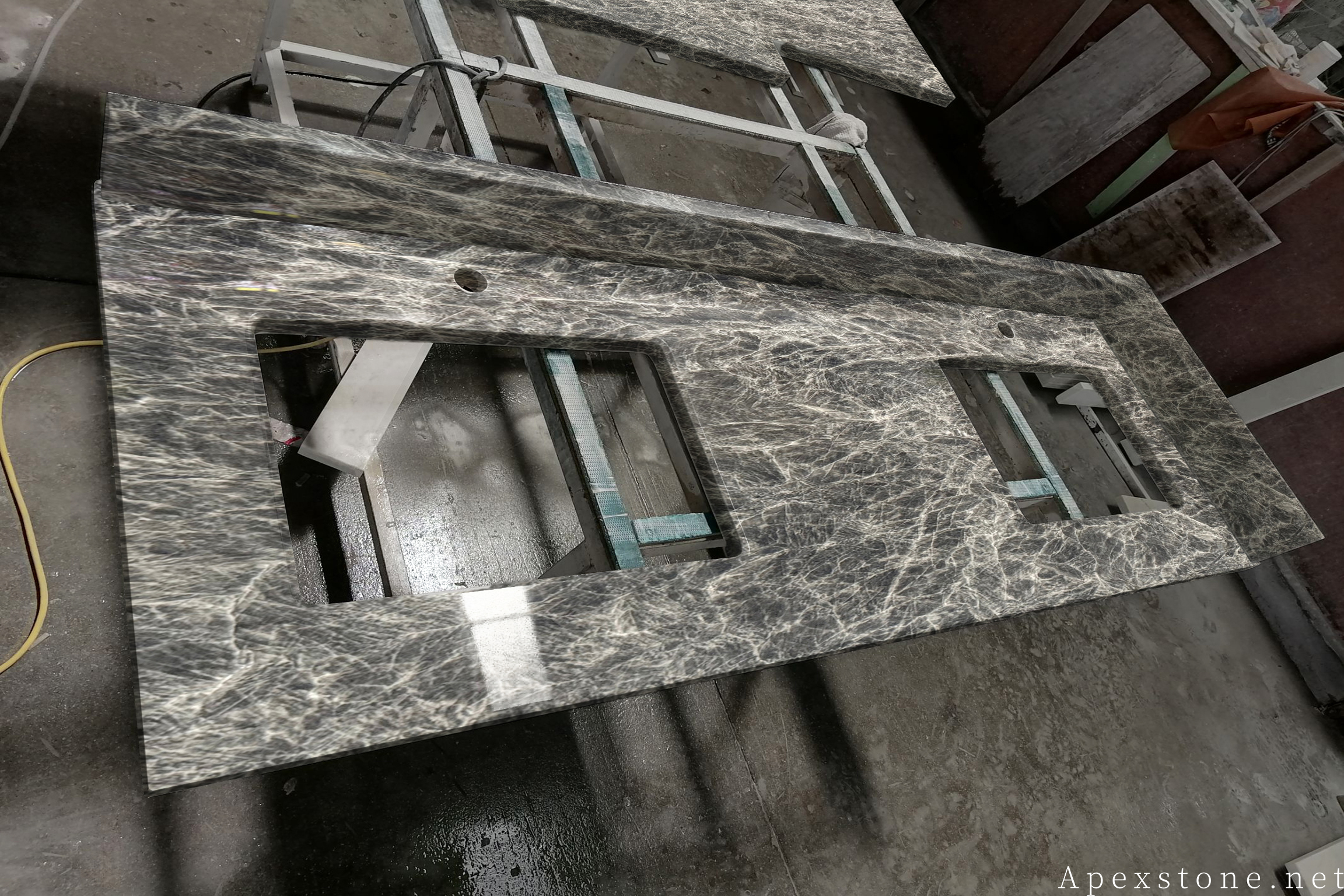
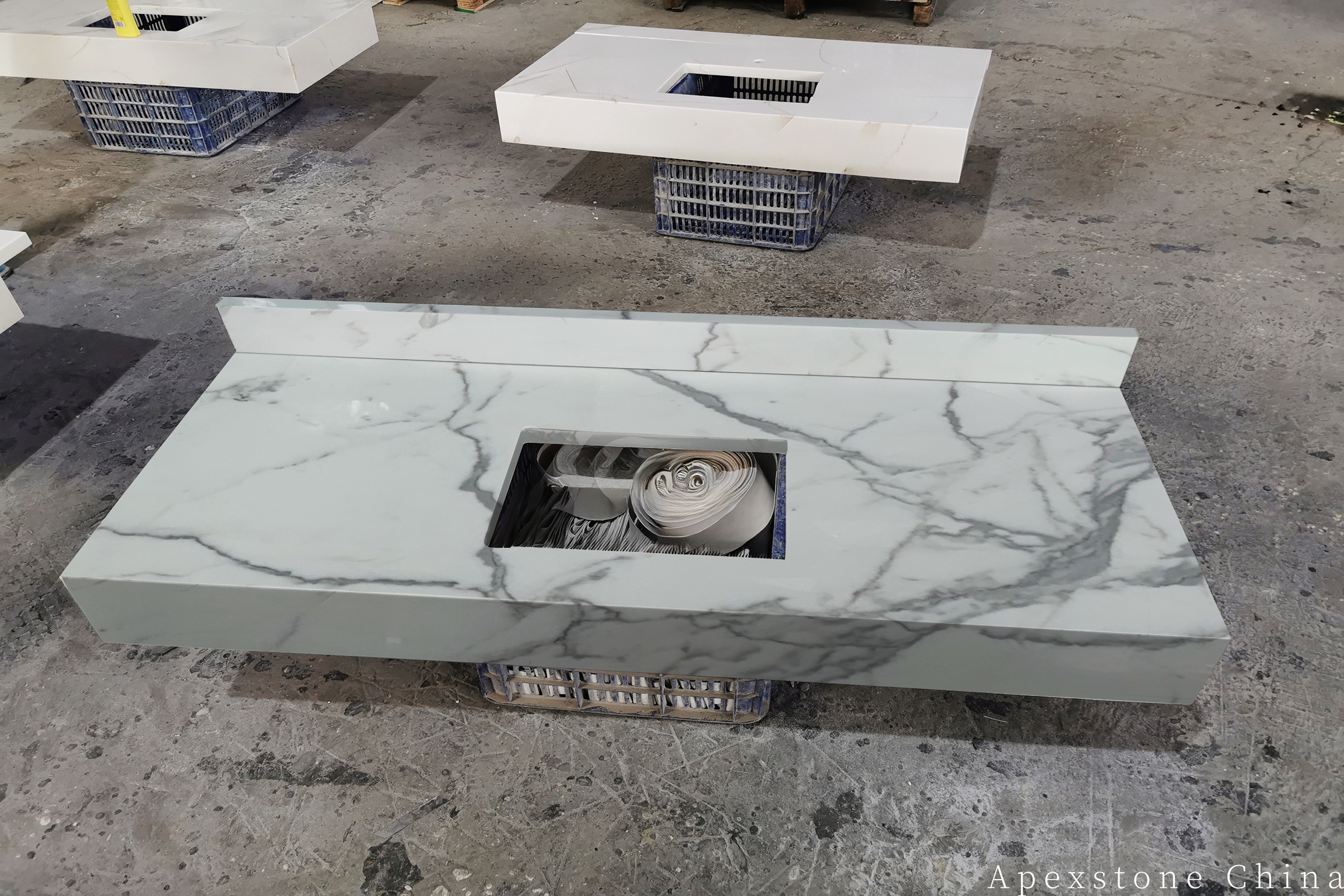
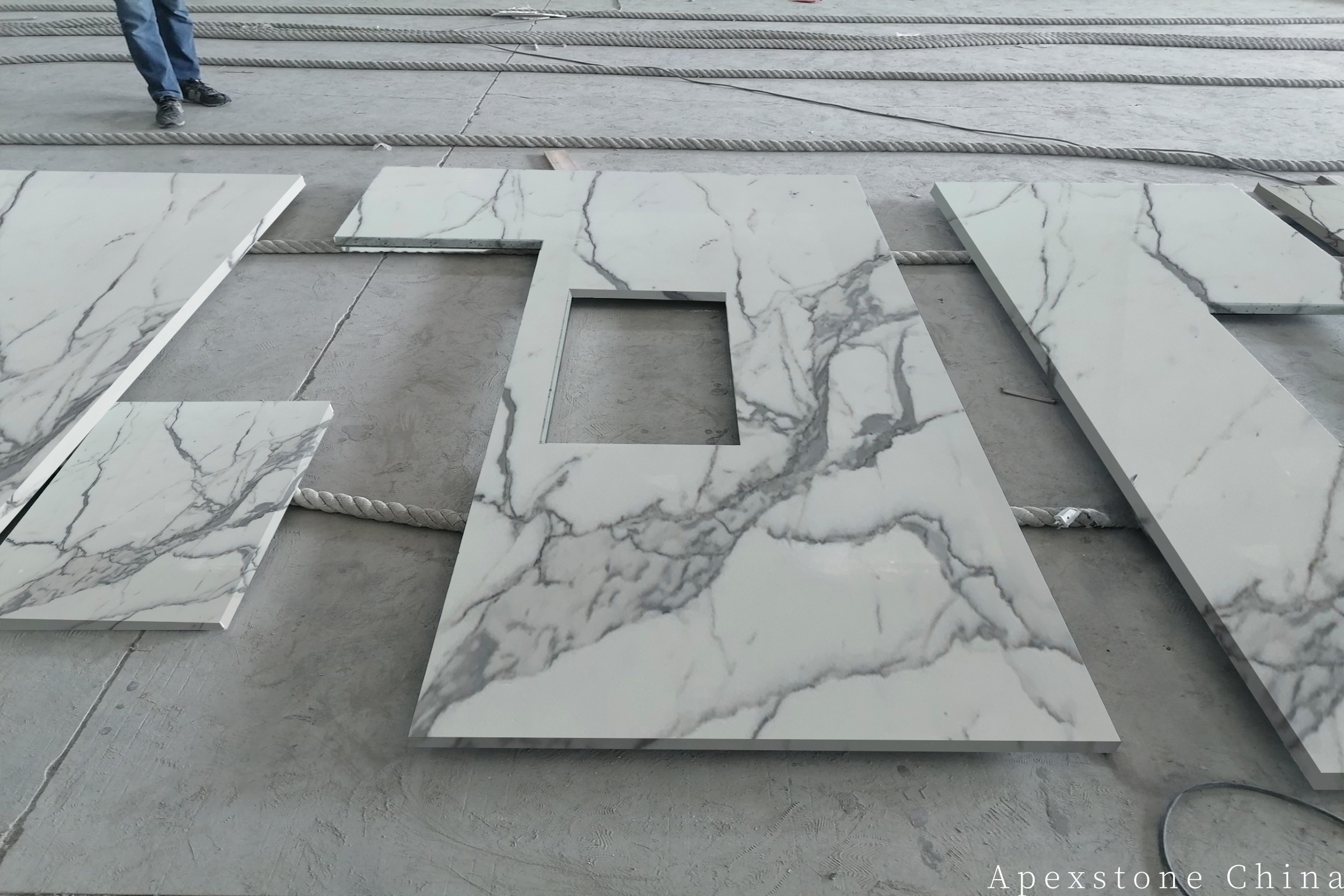
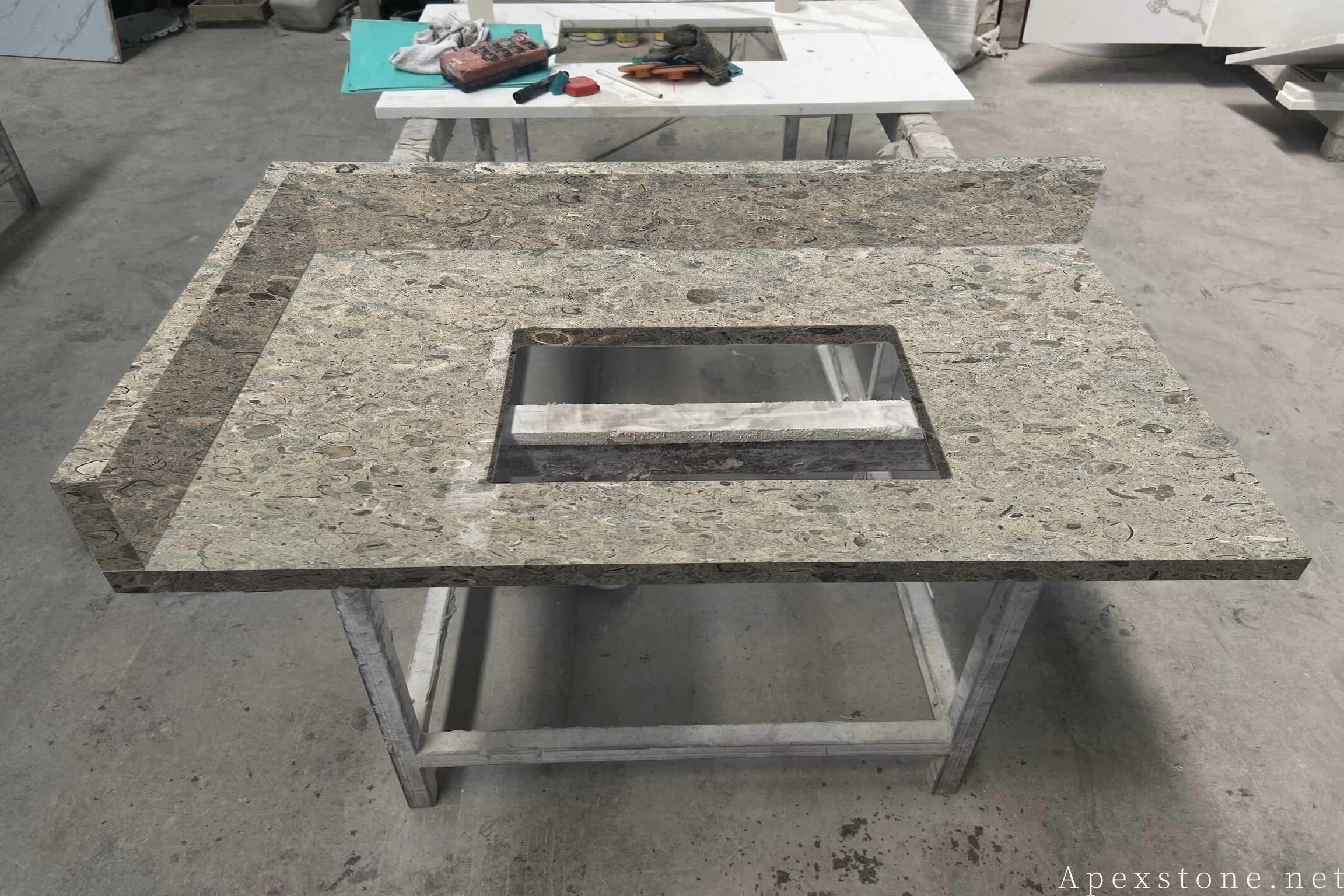
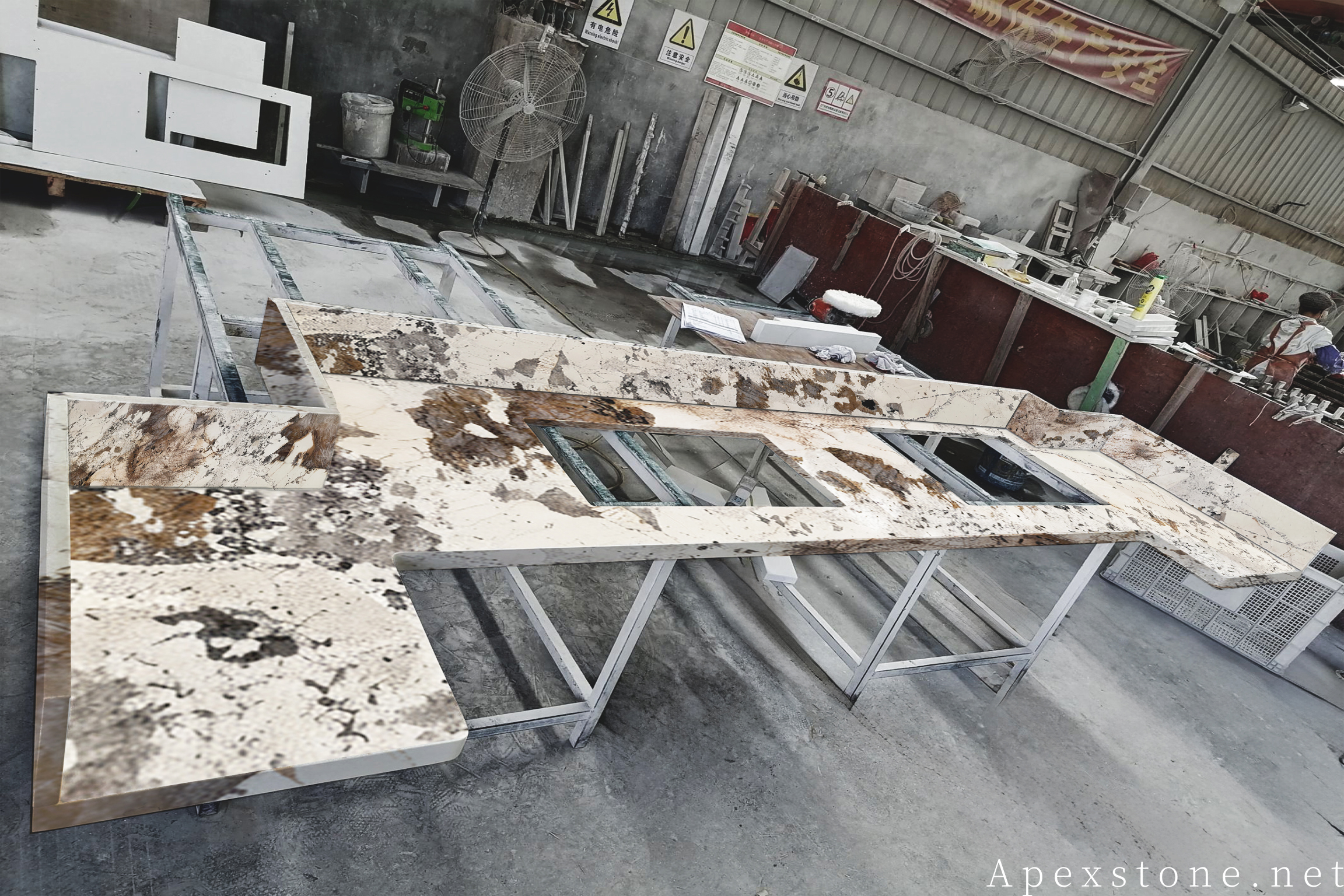
Every Pandora set starts with nesting on the images of the actual slabs. The island is placed first, then waterfall returns and full-height splash panels, then the perimeter runs — 60 in and 72 in base runs, a 36 in sink run, whatever the cabinet plan calls for. Cut-outs for undermount sinks, cooktops and taps are machined on CNC equipment to the manufacturer's template after the drawing is approved, because quartzite does not forgive second thoughts: a moved seam or a cut-out shifted 20 mm cannot be undone. Edge profiles — eased, bevel, small bullnose or a custom ogee for traditional kitchens — are frozen on the same drawing.
Because the pattern is large-scale, we photograph and number every finished piece against the approved layout before packing. The set leaves the workshop labelled in installation order, polished faces protected, so the kitchen that arrives is the kitchen that was drawn. For wholesale and trade buyers this matters more than for anyone: a Pandora project resold to a homeowner is judged on pattern continuity, and a set nested by one workshop will always beat pieces sourced from three.
Living with Pandora day to day
As a quartzite, Pandora handles daily kitchen work well: it shrugs off knife tips far better than marble, tolerates hot pans briefly, and, once sealed, resists water and oil absorption. It is still natural stone — wine, citrus and tomato should be wiped promptly, and sealing is a cycle rather than an event. A pH-neutral cleaner, boards for chopping and trivets for long simmers cover ninety percent of care. Owners who choose the leathered finish generally find it the most forgiving day to day, since texture disguises the small marks a polished plane would show.
Specifying Pandora from Apexstone
Send the cabinet plan, sink and appliance models, preferred thickness and finish, and the destination port. The set comes back as a layout on the actual Pandora slab images — seams, cut-outs, vein direction and waterfall returns all resolved on paper before the first cut. Single-piece orders are accepted for sample and replacement work, and every piece is inspected against the numbered layout before the container is loaded. When one workshop controls cutting, finishing, inspection and packing, the questions that used to travel between three suppliers stop at one desk.